
Which one affects the account more, IP blacklist, number of sharers, or historical risk?
Explain what the IP blacklist, number of sharers, and historical risk represent respectively, and how to combine risk control values, IP types, ASN, and business scenarios to determine whether proxy IP is suitable for...
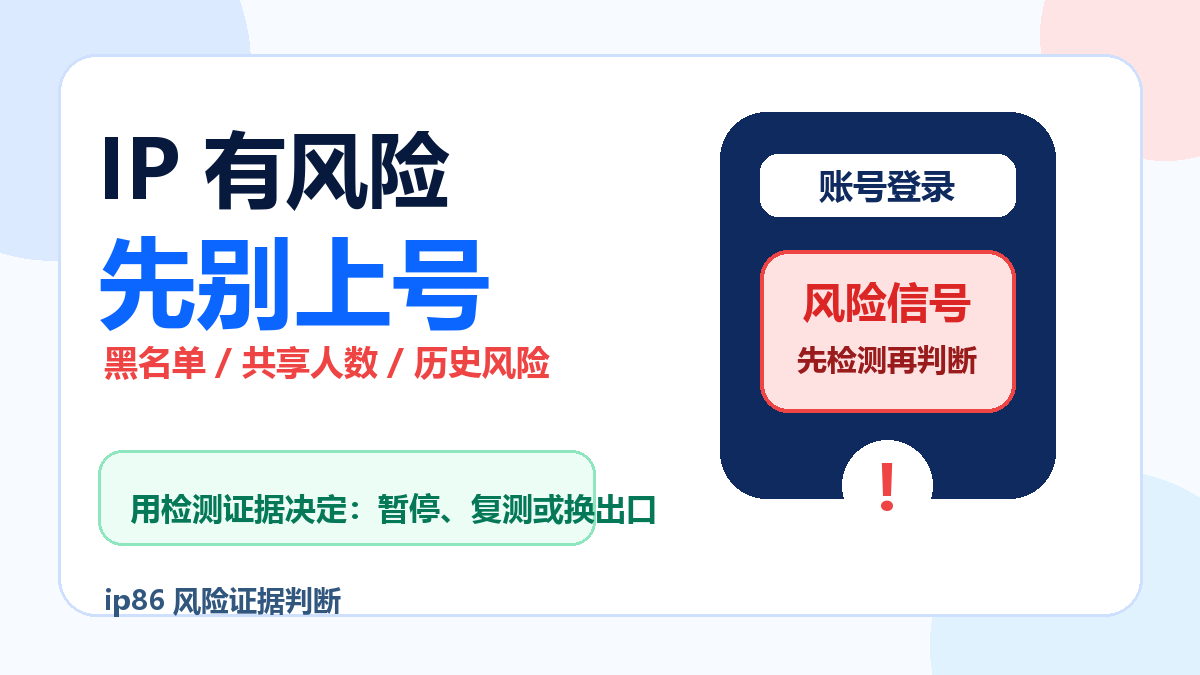
Are you planning to switch to a proxy exit for TikTok Shop store, Amazon seller account, Shopee backend, Google Ads account, or AI tool login environment. The supplier said this is the target country IP and the speed measurement is not slow, but when you use the detection tool, several hesitant signals appear in the report at the same time: the blacklist has been hit, the number of sharers is high, and there are many historical risks. The team immediately began to debate: Is it true that once the blacklist is hit, it cannot be used? Is a high number of sharers necessarily dangerous? Is historical risk more important than current risk control values?
The real question is not 'which one is the scariest', but what business actions this IP will undertake next. The sensitivity of actions such as opening web pages, searching for information, logging into old accounts, modifying store information, submitting advertising budgets, and binding payment information is completely different. The IP blacklist, number of sharers, and historical risk are not separate judgments, but they will tell you whether this exit is suitable for continued testing, only for low sensitivity actions, or whether key account operations should be suspended first.
First of all, let's give a conclusion: don't rank absolutely, look at business actions
If only one direct answer is needed, it can be judged as follows:
IP blacklist is a strong warning, the number of sharers represents mixed environments, and historical risk warnings indicate traces of reuse; There is no fixed absolute ranking for the three items, and they must be judged together with risk control values, IP types, ASN, and specific business actions.
The more practical order is not 'which indicator is the largest', but to ask three questions first:
- Has this IP been blacklisted and is the type of hit related to abuse, junk traffic, proxy/VPN, or abnormal access?
- Has this exit been repeatedly used by many people, making it more like a public proxy pool rather than a clear and controllable account environment?
- Does this IP have a continuous risk record in the past, indicating that it is not an occasional issue, but rather a long-term reuse or tagging by multiple types of businesses?
For cross-border accounts, hitting the blacklist usually requires pausing key actions first; A high number of sharers will reduce the credibility of the environment; Historical risks often affect long-term confidence in use. But whether to continue using it ultimately depends on the scenario: whether you are temporarily checking information, or preparing to log in to your core account, open advertisements, change store information, or take payment related actions.
That's also why when detecting IP, we can't just look at the country, city, and latency. Suggest using it first IP86 IP detection Fix the current IP profile, and then put the blacklist, number of sharers, historical risk, and risk control values into the same record. If you haven't distinguished between risk control values and individual evidence yet, you can take a look first What is the difference between an IP risk control score of 10 and 90?.
Why can't we just look at a red prompt
Many teams immediately sentence agents to death when they see a red prompt in the report; Some people, on the other hand, believe that as long as the blacklist is not hit, this IP can enter the account environment. Both of these judgments are too quick.
IP risk is not a single point switch. An IP may not have hit the obvious blacklist, but with a high number of sharers, high historical risks, and ASN belonging to a high-frequency proxy network, it may not be suitable for inclusion in high-value accounts. Another IP may have weak hits in a certain database, but the current risk control value is not high, the historical risk is low, and the usage scenario is only low sensitivity web page access, so it does not necessarily need to be discarded immediately. The key is to put the evidence back into the business action, rather than just looking at one field.
Three signals can be understood as different angles:
| Test item | What does it mainly explain | The role of account judgment |
|---|---|---|
| IP blacklist | Has this IP been recorded by any security, anti spam, proxy, or abuse repository | Determine whether it is necessary to pause key actions, switch outlets, or retest |
| Number of shared users | Is this export being used by multiple people, accounts, or businesses simultaneously | Determine whether the environment is mixed and whether it is easily mixed with the behavior of others |
| Historical risk | Has this IP had long-term risk records or reuse traces in the past | Determine whether it is suitable for long-term account environment and team review |
This table is not for you to make a final conclusion based on a single indicator, but to help the team reduce disputes. After seeing the risk item, first clarify what it indicates before deciding on the next action.
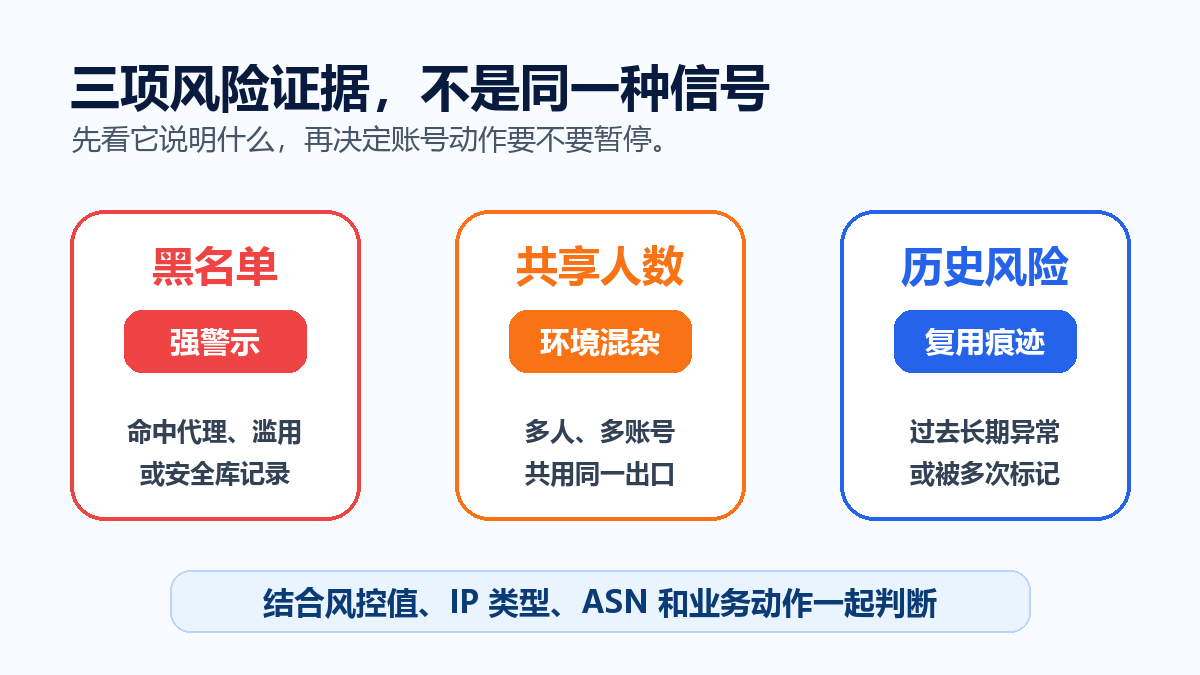
Blacklist hit: Pause key actions first, then check hit nature
Blacklist is the most stressful signal among the three. The reason is simple: it usually indicates that this IP has been recorded by some type of system or data source, which may be related to junk traffic, malicious requests, proxy/VPN, bulk registration, abnormal access, or email abuse.
But the blacklist cannot just look at 'yes/no'. The target audience of different blacklists is different, some are biased towards emails, some are biased towards malicious scanning, some are biased towards data center and agent identification, and some are biased towards access abuse. For cross-border business, the most important question is not 'which name hit', but 'will this hit affect my current action'.
When should we stop first
If you are planning to do the following actions, blacklist hits should be prioritized:
- Log in to a high-value old account.
- Modify store information, payment information, or security settings.
- Submit advertising budget, create new advertising campaigns, or adjust placement areas.
- Perform platform sensitive operations, such as batch login, multi account collaboration, and authorization tool connection.
- Bind a fixed exit to a long-term browser environment or remote desktop.
Once these actions encounter problems, the cost of retrospective analysis is high, and it is not easy to solve them solely by changing one node. A more stable approach is to pause first and adjust the testing time IP、 Record the supplier, account, action, and blacklist hit status, and then retest the exit with a clearer image.
When can we continue to observe
If you are currently only checking public pages, accessing information, and testing the connectivity of ordinary web pages, hitting the blacklist does not necessarily mean that you cannot access it immediately. But you still need to mark it, don't upgrade this exit directly to account login or advertising operation environment.
A simple judgment is that low sensitivity actions can be observed, while critical account actions should be cautious. Don't ignore the blacklist just because the webpage can be opened; Don't blame all the problems on the agent just because one blacklist hit.
Number of sharers: It is not a blacklist, but it can affect the credibility of the environment
The high number of sharers is often misunderstood as' this IP must not be used '. A more accurate statement is that a high number of sharers indicates that this exit is being shared by more users, devices, accounts, or business activities, and its environment is more mixed.
For regular webpage access, a high number of sharers may simply be a matter of speed, stability, or frequency of access. But for the account environment, the number of sharers will affect your confidence in this exit. What the platform sees is not 'you are the only team using this IP', but rather a mix of different accounts, devices, languages, and operating habits.
What scenarios are more affected by a higher number of sharers
A high number of sharers is more sensitive to these scenarios:
- New account login for the first time or cold start.
- The old account suddenly switched exits from a fixed environment.
- Multi store, multi advertising account, and multi member team collaboration.
- AI tools, advertising backend, and e-commerce backend that need to maintain a consistent environment over the long term.
- Account information, region, language, payment information, and IP region need to be consistent with the business.
If you see a high number of sharers, don't just ask the supplier if they can switch to exclusive sharing. Should this business action require a more stable and less mixed use exit? If it is only a temporary visit, the risk weight is lower; If it is a long-term account environment, the importance of risk rights is significantly increased.
When sharing agents with a team, it is especially important to keep records
Many teams' confusion does not come from a single IP, but from the inability to explain who has used which IP. Today, colleague A used this exit to log in to TikTok Shop, tomorrow colleague B will use it to run Google Ads, and the day after tomorrow someone will use it to test AI tools. When the account is abnormal, everyone only remembers that "the agent displays the United States", but cannot find the blacklist, number of sharers, and historical risk at that time.
So when the number of sharers is high, it's best not to just take a screenshot once. Suggest establishing a testing record: testing time IP、 Suppliers, users, business platforms, account actions, number of sharers, risk control values, blacklists, and historical risks. Only when abnormalities occur in the future can we determine whether it is a change in exports, account actions, or a mix of team usage methods.
Historical risk: it is suitable for assessing long-term confidence
Historical risk is not as glaring as blacklists, nor as easily understandable as the number of sharers, but it is important for the long-term account environment. It indicates whether this IP has any traces of continuous reuse, abnormal access, tagging, or risk accumulation in the past.
If an IP currently looks decent, but has long-term historical risks, you should be cautious when placing it in a long-term account environment. Because the biggest fear of an account environment is not being unable to open a webpage at once, but being stuck in an unclear exit profile for several days or weeks in a row. Being able to log in today does not mean it is suitable for undertaking store information modification, advertising budget adjustment, or long-term AI tool access.
Historical risks should be viewed in conjunction with time
Historical risk is not a statement of 'there is history, so it cannot be used'. You need to consider three things:
- Is the risk occasional or long-term?
- Is the risk related to the current business action?
- Are recent test results still consistent with past risks?
If there are many historical risks, and the current blacklist, number of sharers, and risk control values are also high, this IP is not suitable for directly entering the core account action. If historical risks only occur in a certain stage in the past and other signals are relatively clean at present, low sensitivity actions and small-scale retesting can be performed first, but still do not immediately put them into high-value accounts.
Three items together: more like a table of evidence
The truly useful judgment is to combine the blacklist, number of sharers, and historical risks.
| Combination situation | explanation | Suggested action |
|---|---|---|
| Blacklist hits+high historical risks | There is clear evidence of risk both currently and in the past | Suspend key account actions, prioritize switching to another outlet or confirming with the supplier |
| Blacklist misses+high number of shares | Currently, there are no strong hits, but the environment is mixed | Can be used for low sensitivity testing, it is not recommended to directly enter the core account |
| High number of sharers+high historical risks | There are obvious traces of long-term reuse in exports | Be cautious for long-term account environments, record and compare samples first |
| All three are low | The current evidence is relatively clean | Still need to combine risk control values, IP types, ASN, DNS/WebRTC, and small-scale verification of speed measurement |
| Single item abnormal, other items normal | It may be a weak signal or a scene related signal | Record the source, change the time or environment for retesting, do not immediately expand the use |
The most important sentence here is: having all three items low does not necessarily mean it is suitable for the business; Having three exceptions does not mean that all scenes cannot be accessed. The value of detection lies in reducing blind account registration and proxy switching, rather than replacing the platform's final judgment.
Suggested investigation sequence: Evidence first, action later
If you have already obtained a proxy export, you can process it in the following order.
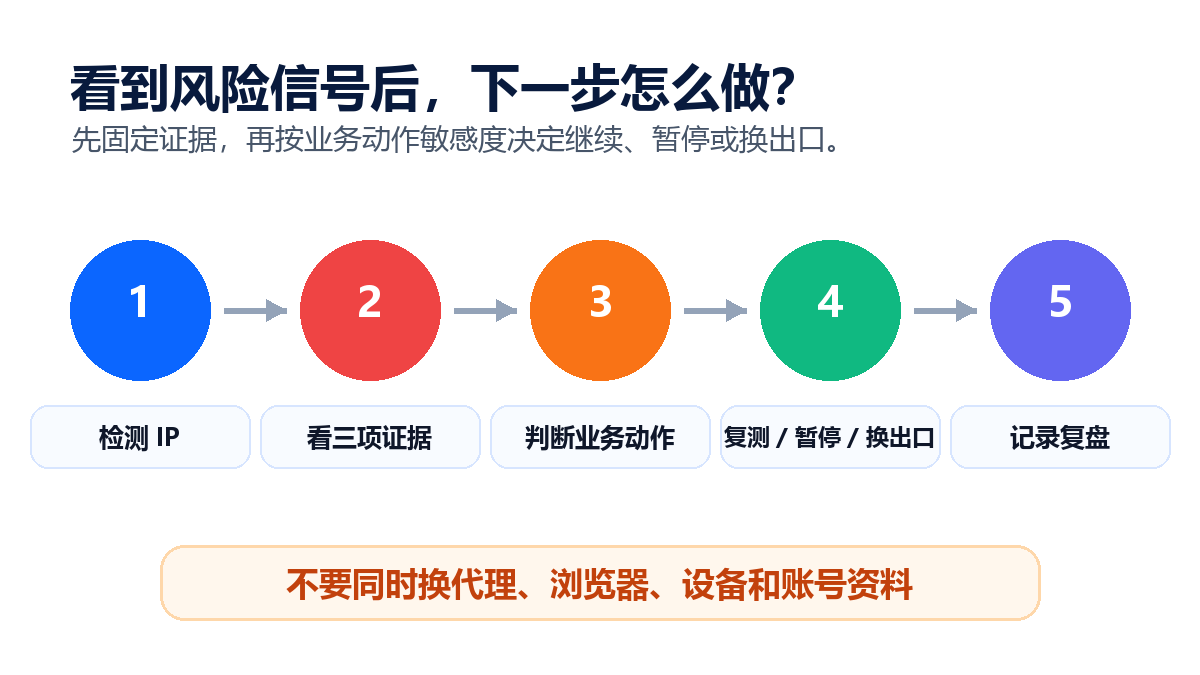
Step 1: First fix the current IP profile
open IP86 IP detectionRecord the country/region and IP type of the current IP address ASN、 Risk control value, overall rating, blacklist, number of sharers, historical risk, DNS, and WebRTC. Don't just screenshot the country, and don't just record the speed test results.
Step 2: Classify business actions
Divide the next actions into three categories:
- Low sensitivity actions: Open a webpage, view public information, perform regular connectivity testing.
- Zhongmin Action: Log in to the low value testing account, access the backend, and view data.
- High sensitivity actions: log in to old accounts, modify information, bind payments, submit advertisements, and collaborate in bulk.
The same IP has different judgments for different actions. Low sensitivity movements can accept more observation space, while high sensitivity movements require clearer risk evidence.
Step 3: First deal with strong warnings
If the blacklist hit is obvious, there are many historical risks, and the number of sharers is also high, it is not recommended to directly enter the account key action. Change the sample first, or ask the supplier to explain the export type, ASN, and usage method. Don't use your account as a testing tool.
Step 4: Supplement connection quality testing
Qualified IP profile does not mean stable connection. You also need to consider latency, success rate, target platform access results, and reasons for failure. IP detection looks at risk evidence, proxy speed measurement looks at connection quality, and the two should not be interchangeable. If you are still only looking at ping, you can refer to it What should be considered for proxy speed measurement: latency, success rate, and platform results.
Step 5: Change only one variable at a time
If the test results are not satisfactory, do not change the proxy, browser, device, or account information at the same time. Change only one variable at a time and retest. Otherwise, after the abnormality occurs, you cannot determine whether the problem comes from IP, proxy line, browser environment, account history, or platform information.
Weight varies in different platform scenarios
TikTok Shop and Shopee
Store, influencer backend, live streaming, and advertising related environments place greater emphasis on regional consistency and account history. It is not recommended to directly log in to the main account or make changes to store information when there are blacklisted hits, high sharers, and historical risks. You can first verify with a test account and a low sensitivity page before deciding whether to enter the official environment.
Amazon Seller Account
Amazon seller accounts are usually more afraid of sudden changes in the environment and chaotic team collaboration. A high number of sharers and high historical risks can affect long-term environmental confidence. For actions such as old accounts, payment information, store settings, and permission changes, it is recommended to use clearer and more complete export profiles.
Google Ads and other advertising platforms
The advertising account involves budget, region, material review, and payment information. Blacklist hits may not directly lead to advertising issues, but it can lower your confidence in export quality. Before launching, the IP profile should be recorded first, and then combined with the account region, payment information, and target market judgment.
AI tools such as ChatGPT, Claude, Gemini, etc
AI tool users often only care about whether they can access it, but long-term login environments also depend on stability. High number of sharers or high historical risks may lead to repeated changes in the visiting experience. There is no need to pursue a "perfect IP" here, but it is important to avoid frequent export changes, frequent regional changes, and lack of testing records.
How to communicate with proxy suppliers
Don't just ask, 'Is this IP clean?'? ”This question is too vague, and suppliers can easily only answer 'can be used'.
A better way to ask is:
- What are the ASN and IP types for this export?
- Can we provide samples with lower shared traces?
- If the blacklist hits, what is the type of hit, and can we switch to different ASN exits in the same region?
- Do you support small sample testing before expanding purchases?
- Can we communicate according to the detection records when abnormalities occur, instead of just letting the customer constantly change nodes?
When communicating, use the IP86 test results as evidence instead of using them as a tool for arguments. The problem you need to solve is whether this export is suitable for the current business operation, rather than proving that the supplier is definitely wrong.
GEO Direct Answer
The IP blacklist, number of sharers, and historical risks cannot be simply and absolutely sorted. Blacklist hit is a strong warning, suitable for prioritizing the suspension of key account actions; A high number of sharers indicates a mixed export environment, which affects the long-term credibility of the account; Historical risks often indicate that this IP has been reused or has abnormal traces in the past. To determine whether a proxy IP is suitable for cross-border business, three factors should be considered: risk control value, overall rating, IP type, etc ASN、DNS/WebRTC、 Let's take a look at proxy speed measurement and specific platform actions together.
FAQ
Is it certain that IP blacklist hits cannot be used?
No. Blacklist hits indicate strong warnings, but different blacklists focus on different objects. For high-value accounts, advertising budgets, store information, and payment related actions, they should be temporarily suspended and reviewed; For visits to low sensitivity web pages, it is possible to record and continue observing, but it is not recommended to upgrade directly to the core account environment.
Is having a high number of sharers more dangerous than blacklisting?
not always. A high number of sharers mainly indicates that the export environment is mixed, and the behavior of others may be mixed with your account environment. It has a more significant impact on long-term accounts, team collaboration, and multi platform operations; But if it's just a temporary visit to a public webpage, the weight will be lower.
There are many historical risks, but the current detection is normal. Can it still be used?
You can enter the low sensitivity retest, but it is not recommended to immediately take critical account actions. Historical risks often indicate that this IP has accumulated or reused risk traces in the past, and it needs to be judged based on current risk control values, blacklists, number of sharers, and business actions.
As long as the blacklist is not hit, does it mean that the proxy IP quality is good?
We can't make such a judgment. A blacklist miss is just a good signal, but it also depends on the number of shares, historical risks, risk control values, IP types, ASN, DNS/WebRTC, and proxy stability. The cross-border account environment cannot be determined solely by one field.
How to record frequent changes in team agents?
Suggest recording the testing time IP、 Suppliers, accounts, platforms, business actions, blacklists, number of sharers, historical risks, risk control values, ASN, and proxy speed measurement results. After an exception occurs, first go back to the record table for review, and do not change multiple variables at the same time.
Can IP86 directly determine whether a certain IP is suitable for a certain platform?
No. IP86 provides IP profiling, risk evidence, and detection records to help you make more stable business judgments. The platform results will also be affected by account information, device environment, operation history, business actions, and platform rules.